


By Tim van den Pol, Portfolio Manager, Farmland Strategy at Van Lanschot Kempen IM
This year, the signal arrived early. Across Europe, extreme heat and dry conditions accelerated crop development, bringing harvest activity forward in several regions and increasing concerns around water stress. Summer had arrived early in the farming calendar¹.
Heat changes the test. It brings harvest forward. It lifts irrigation demand. It exposes light soils. Recent warnings from the World Meteorological Organization and the European Commission’s Joint Research Centre highlight the growing risks of heat and crop-water stress² ³. This is not just weather. Research from Wageningen University makes that point sharper: heat, drought, salinity and flooding are now increasingly interacting stresses that affect crop growth, yield and survival. Farms no longer face one problem at a time. The soil has to buffer several.
What the data shows under drought and heat
Recent field-level research has added a new dimension to that debate. In June 2026, Soil Capital published analysis based on independently verified field-level data from 1,262 farms covering 331,600 hectares across France between 2021 and 2024. The study examined how farms with differing levels of regenerative practice performed during the 2023 droughts⁴.
That is why this data matters. While yields fell across all farms during the 2023 drought, the decline was materially smaller on farms with higher levels of regenerative adoption. The table below shows the difference:
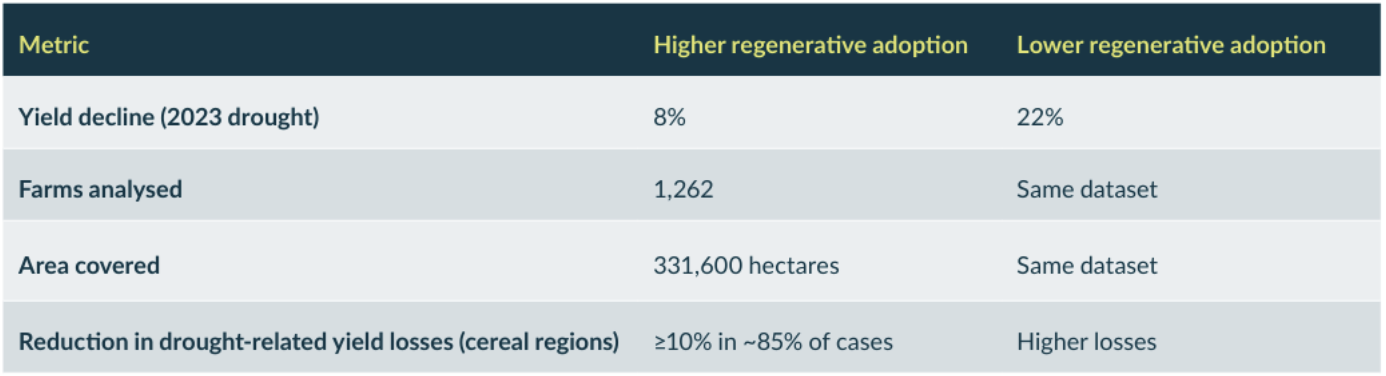
Source: Soil Capital analysis of 1,262 French farms across 331,600 hectares, published June 2026.
Do you want to know more? Please visit our website to read more or to download our whitepaper Natural Capital 3.0
Sources:
- Farmers Weekly, Hot spell drives early barley harvest in eastern England, 29 June 2026.
- World Meteorological Organization, Record-breaking heat spreads through Europe, 29 June 2026
- European Commission JRC MARS Bulletin, Crop monitoring in Europe – June 2026, 22 June 2026.
- Soil Capital, analysis of 1,262 French farms, June 2026.
Disclaimer
This document is for information purposes only. It does not constitute investment advice, an investment recommendation, research, or an invitation to buy or sell any financial instruments. The views expressed are those of Van Lanschot Kempen Investment Management as at the date of publication and may be subject to change. References to sustainability frameworks and outcomes are illustrative and do not constitute a commitment to achieve specific environmental or social outcomes. Van Lanschot Kempen Investment Management NV is authorised as a manager of UCITS and AIFs and is supervised by the Netherlands Authority for the Financial Markets (AFM).
Farmland / permanent crop strategy–specific risks
Investing in farmland and permanent crop strategies involves exposure to illiquid assets, assets that may be difficult to value, and assets subject to agricultural, operational, market and climate related risks. Returns may be affected by weather events, crop yields, commodity markets, biological risks, input cost volatility, interest rate movements, regulatory developments, and sustainability related factors. Under unusual market conditions these risks can increase significantly, which may limit the ability of the investor or the fund to sell assets at preferred times or valuations. The ability of the fund to respond to market movements may be impaired, and adverse price movements may occur when assets are sold.
Use of investment cases and individual properties
Any references to specific farms, properties, operating partners or other entities are included solely as illustrations of the fund’s investment approach. They do not constitute a recommendation to buy or sell any financial instruments associated with those entities. VLK Investment Management may hold positions in the companies or assets mentioned.
Sustainability considerations
Sustainability related objectives and assessments form part of the strategy’s investment process but do not guarantee improved outcomes or fund performance. Sustainability risks may materially affect investment values. Regulatory requirements or market standards relating to sustainability may change over time, which can influence investment decisions, classifications or reported outcomes.


