

By xxxx, xxxxx at Van Lanschot Kempen IM
Markets often focus on what investors are willing to pay for a company today. Long-terminvestors, however, should pay equal attention to what that company can earn in the years to come.
Looking back over the past decade, European small caps have delivered a markedly different experience from what their underlying business performance might suggest. Understanding this disconnect can reveal an attractive opportunity for patient investors.
Investing is a broad discipline and different investors seek to generate returns in different ways. Some focus on sectors, others on regions or different investment styles. One of the most important, yet often overlooked, dimensions, however, is time. An investor’s holding period has a profound influence on where returns ultimately come from and what an investment decision should be based on.
In the short term, share prices are heavily influenced by changes in valuation multiples. Investor sentiment, macroeconomic developments, interest rates and market positioning can all cause a stock to become more or less expensive relative to its fundamentals. As a result, short-term returns are often driven less by what a company achieves and more by how the market chooses to value these (targeted) achievements. At times, markets can become overly pessimistic as well as excessively optimistic in this respect. Just think of all the market gyrations triggered by US politics over the past two years.
What drives returns over time?
Over longer periods, however, a different force tends to become dominant. The longer an investor owns a business, the greater the share of returns that is driven by underlying growth in earnings, cash flows and intrinsic value.
Source: xxxxxxx
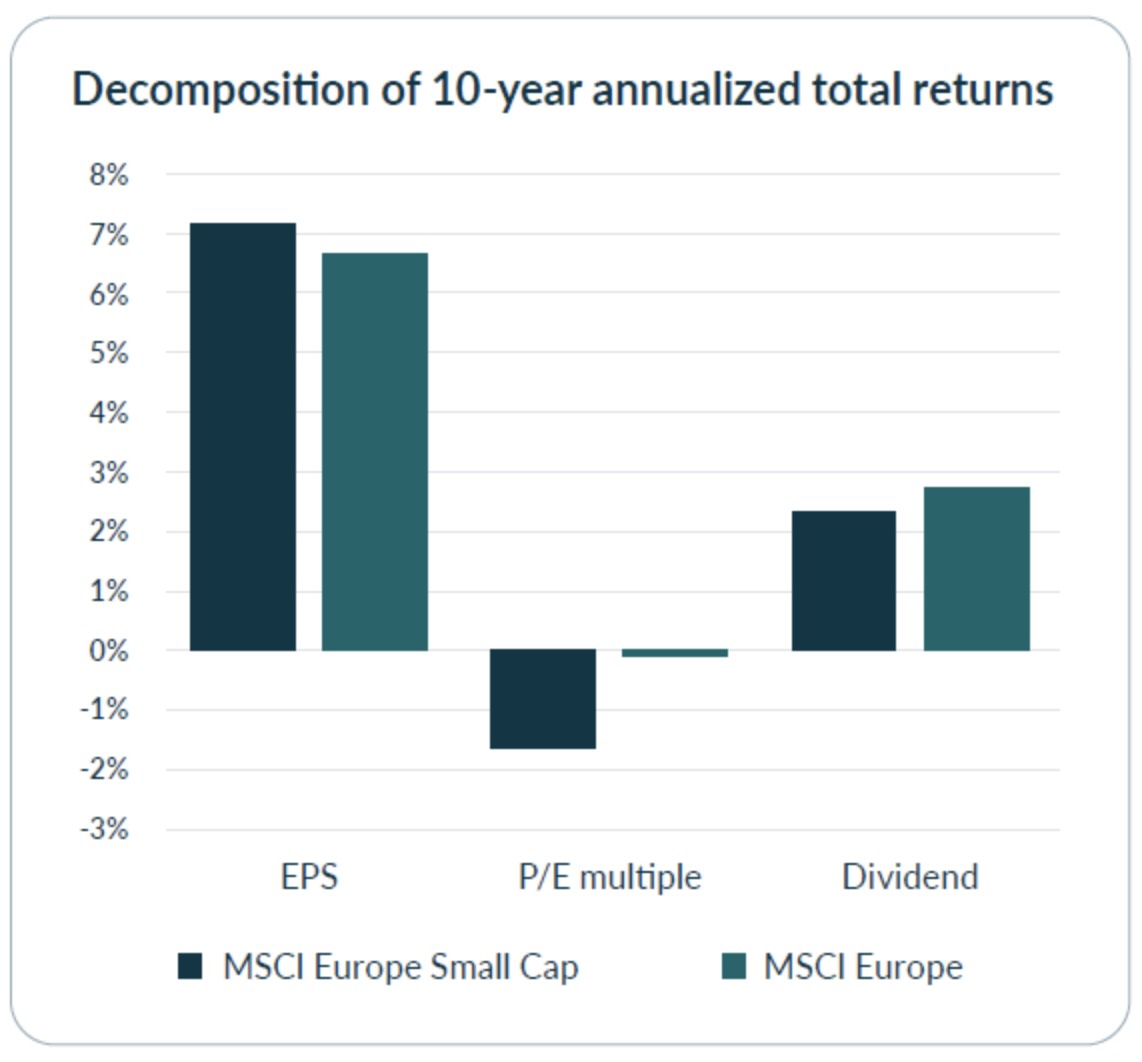
As shown in the chart above growth in earnings per share (EPS) has been the primary driver of returns for both the MSCI Europe Small Cap Index and the MSCI Europe Index
over the last ten years, In fact, the contribution from EPS growth was slightly higher for small cap companies than for large cap companies over this period.
This suggests that from a business fundamentals perspective, European small caps have been at least as successful in growing earnings as their European large cap peers.
The missing piece: valuation
The chart also shows the contribution to returns from changes in valuation, as measured by the price to earnings (P/E) multiple, or the price investors are willing to pay for each euro of a company’s earnings. Here we see that compared with earnings growth and dividend, changes in valuation played a much smaller role in determining total return over the period under review.
The P/E multiple metric also highlights an important difference between small and large caps, with small caps experiencing a much larger contraction in valuation multiples. Large caps started the ten-year period with a price to earnings (P/E) multiple of 14.9x and as per end of August 2026 traded at an almost unchanged multiple of 14.8x. Small caps, by contrast, saw their P/E multiple decline from 19.1x to 14.0x over the same period of time.
This reduction of valuation multiples created a drag on returns and helps explain the relative underperformance of small caps in recent years. While small-cap companies delivered strong earnings growth, investors became less willing to pay a premium for those earnings.
Looking ahead: an opportunity not to be wasted
However, just like driving a car, investing is primarily a forward-looking discipline. Given the strong earnings growth delivered by small-cap companies over the past decade, we believe the current valuation gap does not reflect their underlying fundamentals. This is why we see the current lower P/E multiple of European small caps (14.0x) relative to large caps (14.8x) as an attractive entry point for long-term investors. In our view, adding small caps to a diversified portfolio allows investors to benefit from a potential normalisation of this valuation difference, alongside continued long-term earnings growth.
Would you like to know more?
Please visit our website to download our whitepaper “Better bet on small caps.” In this paper we explore the case for small caps in today’s market environment. From the real-economy beneficiaries of AI investment to attractive relative valuations and diversification from concentrated large-cap indices, our latest research examines why the asset class may deserve renewed attention.
Disclaimer
Van Lanschot Kempen Investment Management ( VLK IM) is licensed as a manager of various UCITS and AIFs and authorised to provide investment services and as such is subject to supervision by the Netherlands Authority for the Financial Markets. This document is for information purposes only and provides insufficient information for an investment decision.
As asset manager VLK IM may have investments, generally for the benefit of third parties, in financial instruments mentioned in this document and it may at any time decide to execute buy or sell transactions in these financial instruments.
This document has been produced independently of the companies mentioned, and the views contained herein are entirely those of VLK Investment Management.
This document does not contain investment advice, no investment recommendation, no research, or an invitation to buy or sell any financial instruments, and should not be interpreted as such. The opinions expressed in this document are our opinions and views as of such date only. These may be subject to change at any given time, without prior notice.
General risks to take into account when investing in small-cap strategies
Please note that all investments are subject to market fluctuations. Investing in a small-cap strategy may be subject to country risk, equity market risks and small cap company risk, which could negatively affect the performance. Under unusual market conditions the specific risks can increase significantly.
Potential Investors should be aware that changes in the actual and perceived fundamentals of a company may result in changes for the market value of the shares of such company. Equities of companies with small capitalization can be more volatile than equities of mid and large companies and may also be less liquid.
Capital at risk
The value of investments and the income from them can fall as well as rise and are not guaranteed. Investors may not get back the amount originally invested. Past performance provides no guarantee for the future.


